Normes de l'appareil d'essai d'impact pour chaussures de sécurité : Explications des normes GB/T, ISO, EN
La résistance aux impacts est un indicateur essentiel des performances de protection des chaussures de sécurité. La chute d'objets lourds sur les chantiers de construction, dans l'industrie, la logistique et les mines peut frapper la zone des orteils, et des embouts défectueux entraîneront de graves blessures par écrasement du pied.
Un appareil d'essai d'impact pour chaussures de sécurité mesure la déformation résiduelle de l'embout après un impact à énergie cinétique fixe, aidant les fabricants à vérifier les performances de protection des produits avant la production en série et l'expédition.
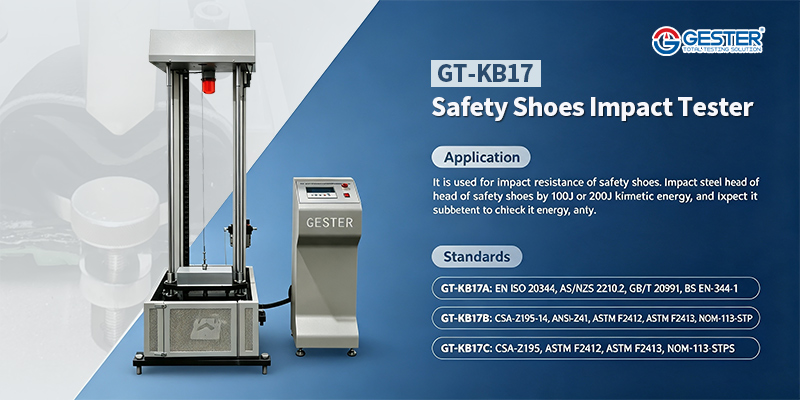
Comment fonctionne l'essai d'impact pour chaussures de sécurité
L'essai d'impact des chaussures de sécurité simule la chute verticale d'un objet lourd sur l'embout de la chaussure via un marteau à chute libre. L'échantillon d'essai (chaussure de sécurité complète) est fixé sur une forme d'essai standard à l'intérieur de la machine. L'électroaimant soulève le marteau d'impact à une hauteur étalonnée, puis libère le marteau pour générer l'énergie d'impact définie (100J, 101,7J ou 200J) afin de frapper l'embout.
Après l'impact, les opérateurs mesurent le dégagement résiduel minimal entre l'embout déformé et la forme d'essai pour déterminer si la chaussure répond aux exigences de sécurité.
GT-KB17 Appareil d'essai d'impact pour chaussures de sécurités améliorent la précision des tests grâce à une armoire de commande indépendante, une barrière de protection anti-éclaboussures et deux vérins amortisseurs pour éliminer les interférences des impacts secondaires.
Normes de l'appareil d'essai d'impact pour chaussures de sécurité et aperçu
|
Norme d'essai d'impact |
Région d'utilisation |
Méthode d'essai |
|
EN ISO 20344 |
Utilisé à l'international, adopté en Europe |
Essai d'impact par chute de poids (zone des orteils) |
|
EN ISO 20345 |
Utilisé à l'international, adopté en Europe |
Essai d'impact par chute de poids (classement 200J) |
|
ISO 22568 |
Utilisé à l'international |
Essai de résistance aux impacts de l'embout |
|
AS/NZS 2210.2 |
Principalement utilisé en Australie et en Nouvelle-Zélande |
Essai d'impact par chute de poids |
|
GB/T 20991 |
Principalement utilisé en Chine |
Essai d'impact par chute de poids |
|
BS EN 344 |
Principalement utilisé au Royaume-Uni et en Europe |
Essai de résistance aux impacts des orteils |
|
BS 953 |
Principalement utilisé au Royaume-Uni |
Essai d'impact pour chaussures de protection |
|
ASTM F2412 |
Principalement utilisé aux États-Unis |
Méthode d'essai d'impact par chute de poids |
|
ASTM F2413 |
Principalement utilisé aux États-Unis |
Spécification de performance d'impact |
|
CSA Z195 |
Principalement utilisé au Canada |
Test d'impact par chute calibrée (125J / 90J) |
|
ANSI Z41 |
Anciennement utilisé aux États-Unis |
Test de résistance à l'impact sur la pointe du pied |
|
NOM-113-STPS |
Principalement utilisé au Mexique |
Test d'impact pour chaussures de travail |
L'appareil de test d'impact pour chaussures de sécurité suit le même principe de simulation d'impacts d'objets en chute tout en permettant différents niveaux d'énergie, configurations d'échantillons et formats de rapports.
Toutes ces normes aident les fabricants à évaluer en continu les performances de protection des chaussures et à garantir que les produits répondent aux exigences de sécurité des clients et du marché.
Exigences de conformité régionale
Les entreprises qui fournissent des chaussures de sécurité aux marchés internationaux ont souvent besoin d'un appareil de test d'impact pour chaussures de sécurité conforme à de multiples normes d'essai.
Cela permet d'éviter de nouveaux tests, réduit les retards de certification et simplifie également la gestion de la qualité mondiale sur différents marchés d'exportation.
Similitudes et différences
Presque toutes les normes utilisent un système d'impact à pendule ou à masse tombante pour mesurer la résistance à l'impact de l'embout. Cependant, la préparation des éprouvettes, les exigences de conditionnement, les niveaux d'énergie d'impact, les limites de dégagement ainsi que le calcul des résultats peuvent varier d'une norme à l'autre.
Un appareil de test d'impact pour chaussures de sécurité moderne améliore les performances grâce au contrôle automatique du déclenchement et à la gestion numérique des données, et aide les laboratoires à maintenir une conformité fiable face à diverses exigences de test.
Les tests d'impact sont indispensables pour l'assurance qualité des EPI de sécurité
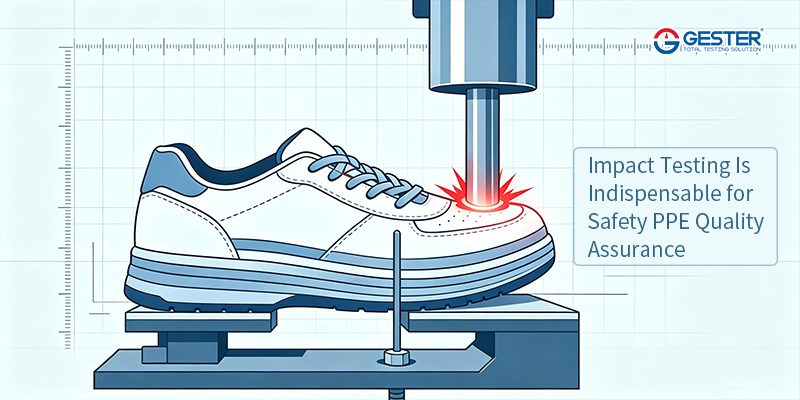
Maîtrisez les différences des normes mondiales pour une exportation fluide
EN ISO 20344, EN ISO 20345, ISO 22568, AS/NZS 2210.2, GB/T 20991, BS EN 344, BS 953, ASTM F2412, ASTM F2413, CSA-Z195, ANSI-Z41, NOM-113-STPS adoptent tous le principe du test d'impact par marteau à chute libre mais desservent des marchés de certification régionaux distincts. Chaque norme possède des règles de paramètres uniques pour la préparation des échantillons, l'énergie d'impact et l'évaluation des résultats.
Un appareil de test d'impact universel pour chaussures de sécurité peut couvrir les tests d'embouts en métal/composite et de dispositifs de protection métatarsienne pour toutes les normes.
Valeur du choix d'un testeur d'impact adapté aux normes
Les testeurs d'impact multi-normes avancés tels que GESTER GT-KB17 Safety Shoes Impact Tester améliorent la précision des tests et le débit du laboratoire grâce à l'étalonnage automatique, la gestion numérique des données et la commutation de modes multi-normes. Ils simplifient la gestion de la conformité transfrontalière, réduisent les coûts d'exploitation des tests à long terme et génèrent des données de test crédibles et reconnues à l'échelle internationale pour les programmes mondiaux d'inspection et de certification des chaussures de sécurité.
Foire aux questions
Quelles normes internationales la machine de test de chaussures de sécurité GT-KB17 respecte-t-elle ?
La machine répond pleinement aux exigences des tests de résistance aux chocs EN ISO 20344 et prend également en charge les protocoles de test correspondants pour les normes de chaussures de sécurité ANSI, ASTM et CSA pour l'exportation sur le marché mondial.
Quel rôle joue cette machine de test de chaussures de sécurité dans les stratégies de contrôle de la qualité des chaussures de sécurité ?
Elle permet la vérification des performances à un stade précoce des embouts de chaussures aux stades des prototypes, des produits semi-finis et finis.
Quels sont les composants principaux de l'appareil de test d'impact pour chaussures de sécurité GT-KB17 ?
Les composants clés comprennent l'ensemble marteau d'impact, l'unité de levage électromagnétique, les deux cylindres amortisseurs, la clôture de protection périphérique complète, le boîtier de commande numérique séparé, le dispositif de serrage de chaussure réglable et les accessoires d'argile de mesure standard requis par la norme EN ISO 20344.


Liens amicaux :
 français