What Is Martindale Abrasion Tester and Why Does It Matter in Textile? February 11 , 2026

What Is Martindale Abrasion Tester and

Why Does It Matter in Textile?


In the textile industry, product quality is not only reflected in appearance design and hand feel, but more importantly in actual performance during use. In daily use, fabrics are subjected to different degrees of abrasion as well as fuzzing and pilling. The Martindale Abrasion and Pilling Tester can meet the requirements for testing abrasion resistance and anti-pilling performance.


So, what is a Martindale abrasion tester? Why is it so important in the textile industry? This article will give you a comprehensive explanation.
What Is Martindale Abrasion Tester?

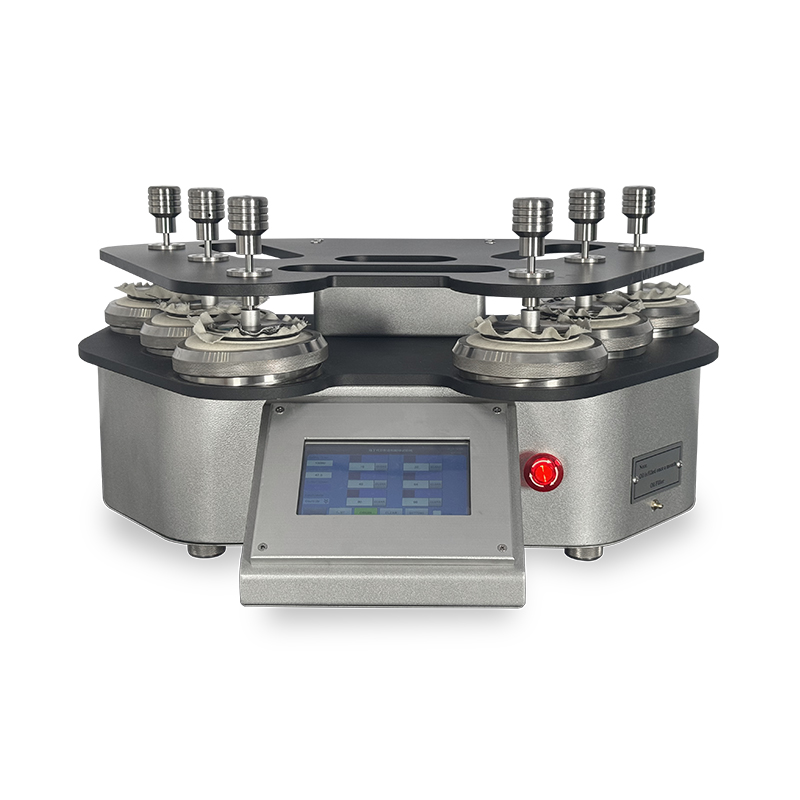
The Martindale abrasion and pilling tester is used to determine the abrasion and pilling resistance of all kinds of textile structures.

Samples are rubbed against a known abradant at low pressures and in continuously changing directions, and the amount of abrasion or pilling is compared against standard parameters.

The upgraded Martindale abrasion and pilling tester features several improvements. It is driven by a dual servo system, which enhances its performance and accuracy. The tester generates a standard Lissajous figure motion trajectory.

Why Does Martindale test Matter in Textile?

Garments are prone to pilling due to friction during wear, making fabric abrasion resistance and anti-pilling properties particularly vital.

1. Assessing product durability

Abrasion resistance directly impacts a product's lifespan. For instance, upholstery fabrics, workwear, or outdoor apparel lacking sufficient abrasion resistance may quickly develop damage or pilling issues. The Martindale abrasion test method significantly benefits fabric quality, reducing customer complaints and returns. This test indicates whether textiles can withstand anticipated wear and tear.

2. Compliance with International Standards

Numerous international brands, buyers, and testing bodies impose explicit requirements for fabric abrasion resistance and pilling performance. GESTER Martindale Abrasion Tester complies with multiple international and industry standards, including:

Abrasion: GB/T 21196.2, GB/T 13775, ISO 12947, ASTM D4966, CEN/TS-16611, IWS TM 112,

M﹠S P19, Next 18, SN 198529, TWC 112, JIS L1096 (ISO17076-2 ball plate method, optional), EN388 Section 6.1, EN 13770

Pilling: GB/T 4802.2, ISO12945-2, ASTM D4970, IWS TM 196, M﹠S P17, Next TM26, SN 198525, CEN/TS-16611

3. Supporting Product Development

Martindale testing assists R&D personnel in comparative analysis and optimising process parameters. Concurrently, conducting spot checks during production helps stabilise product quality and reduce after-sales risks. Martindale abrasion testing aids in selecting the appropriate textile for each application.

Features of the Martindale Abrasion Tester

Martindale fabric abrasion test standard: Lissajous figure, straight line. Working positions: 4, 6, 8, 9 optional. Standard sample holders with 9 and 12 kPa weights included.

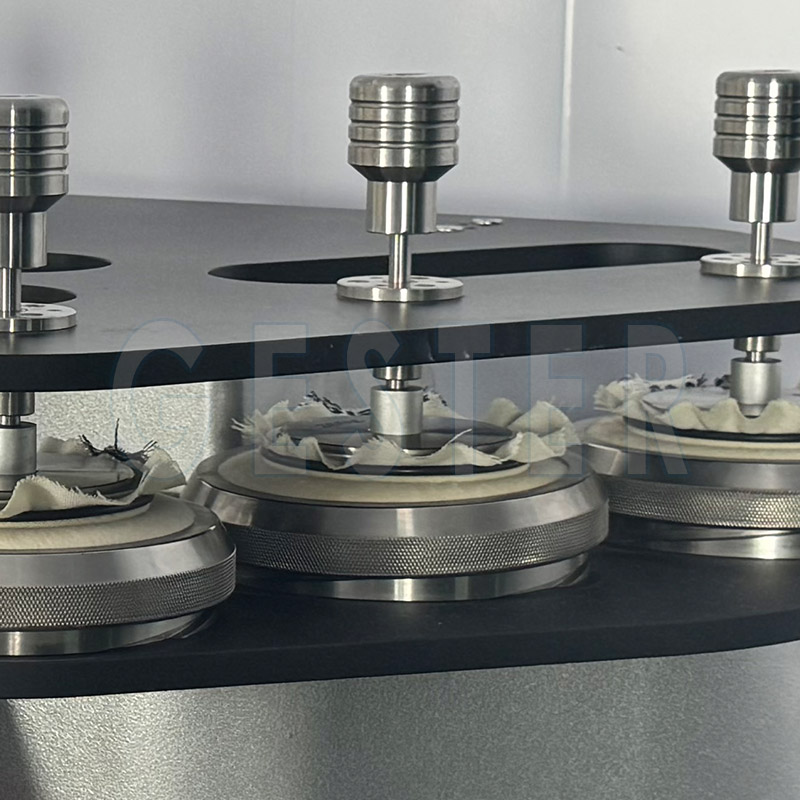
To prevent distortion, the top motion plate is specially made of 316 aluminum alloy. Instead of the structure supported by steel balls, the new and upgraded design avoids the risk of uneven cover plate caused by ball wear. The cover plate can be folded and turned up to facilitate sample loading and observation of test results.

Standard sample holders with 9 and 12 kPa weights are included. Weights and key components are made of stainless steel, which is well-formed and durable in use.

Martindale abrasion test, PLC control, 7-inch color touch screen, Chinese and English operation interface.

The added lubricating oil injection hole is convenient for customers to maintain and ensures that the machine can run stably for a long time.


Martindale Abrasion Tester Procedure


1. Remove the pallet, unscrew the fixture. First put a φ140mm wool felt on the surface of the fixture, and then put a φ140mm friction cloth, flatten it with a pressure tuft, and lock the fixture.

2. Unscrew the fixture, put the sample cut out with the φ38mm cutting sample board, and then pad a φ38mm foam pad, and put the clamp to the position of the above picture to fix and lock.

3. Insert the pin into the hole on the edge

4. Fix the pallet on the machine steadily. Note: The 3 pins should be stuck in the middle of the U-shaped groove

5. Put the installed fixture sample on the grinding disc and insert the extension rod with 9KA or 12KPA weight, the sample installation is complete.

6. Turn on the power, enter the test interface, and perform test settings.

7. Clear the number of previous tests and press to start the test.
When the progress bar below or the machine has run for the set number of times, the machine automatically stops and the test is completed.

Laisser un message
Si vous êtes intéressé par nos produits et que vous souhaitez en savoir plus, veuillez laisser un message ici, nous vous répondrons dès que possible.

Accueil

Des produits

whatsapp